
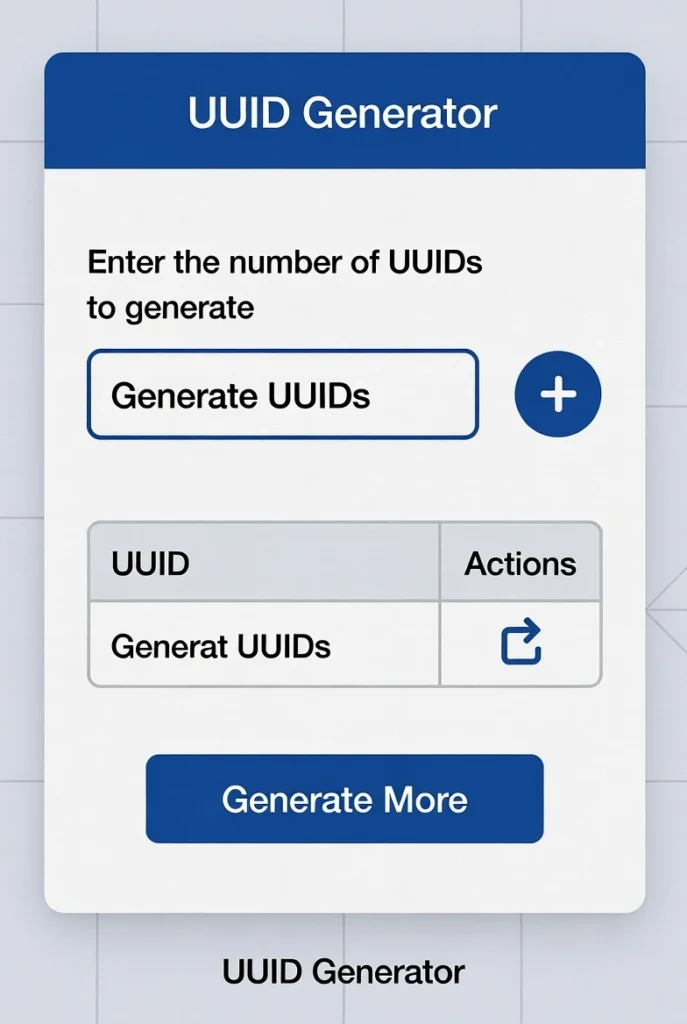
UUID Generator
About this tool: Generate UUIDs (Universally Unique Identifiers) in different versions and formats. UUIDs are 128-bit identifiers that are guaranteed to be unique across both time and space.
How to use:
- Select the UUID version you want to generate (v1, v4, etc.)
- Choose formatting options like uppercase or no dashes
- Click “Generate UUID” to create a new UUID
- Generate multiple UUIDs by setting the quantity
- Copy generated UUIDs to clipboard with one click
Generated UUIDs
-
v4 Click “Generate UUID” to create UUIDs
UUID Generator | Create Unique Identifiers Online
Generate random UUIDs instantly for development, databases, and applications. Our free UUID generator creates version 4 UUIDs that are cryptographically secure.
Introduction
Need a guaranteed unique identifier for your database records, application components, or distributed systems? Manually creating unique IDs is risky and inefficient. A UUID generator provides mathematically guaranteed uniqueness across systems and time. This guide will explain UUIDs and show how our free tool helps developers create reliable identifiers instantly.
What is a UUID Generator?
A UUID (Universally Unique Identifier) generator is a tool that creates 128-bit numbers guaranteed to be unique across space and time. These identifiers are essential for distributed systems where coordination between different components is impossible.
Our professional generator creates:
- Version 4 UUIDs (random)
- Standard format (8-4-4-4-12)
- Cryptographically secure random numbers
- Lowercase and uppercase options
- Batch generation for multiple IDs
Why UUIDs are Essential in Development
UUIDs solve critical problems in software development and data management.
1. Database Record Identification
Create unique primary keys without database coordination, perfect for distributed systems.
2. Distributed System Coordination
Generate unique IDs across multiple servers without communication between them.
3. Security and Anonymity
Use UUIDs instead of sequential IDs to prevent enumeration attacks and hide record counts.
4. Conflict-Free Replication
Merge data from multiple sources without ID collisions during synchronization processes.
Understanding UUID Versions
Different UUID versions serve different purposes and use cases.
Version 4 (Random)
- Most commonly used version
- 122 random bits
- Extremely low collision probability
- Perfect for most applications
Version 1 (Time-based)
- Based on MAC address and timestamp
- Predictable sequence
- Privacy concerns due to MAC address exposure
Version 3/5 (Name-based)
- Generated from namespace and name
- Deterministic - same input always produces same UUID
Key Features of Our UUID Generator
Our tool provides enterprise-grade UUID generation with these features.
- Cryptographic Security: Uses cryptographically secure random number generation
- Batch Generation: Create multiple UUIDs simultaneously
- Format Options: Standard UUID format with case customization
- Copy-Paste Ready: One-click copying for immediate use
- No Dependencies: Works entirely client-side for maximum privacy
Common UUID Use Cases
UUIDs solve identification problems across various development scenarios.
Database Applications
- Generate unique primary keys for new records
- Create foreign keys for relationship mapping
- Establish unique constraints across distributed databases
Microservices Architecture
- Track requests across multiple services
- Correlate logs and events in distributed tracing
- Identify entities across service boundaries
File and Resource Management
- Generate unique filenames for uploaded content
- Create unique resource identifiers in APIs
- Track temporary files and cache entries
How to Generate UUIDs in 3 Steps
Creating unique identifiers takes just moments with our streamlined process.
- Select Quantity: Choose how many UUIDs you need
- Choose Format: Select uppercase or lowercase
- Generate and Copy: Create UUIDs and copy with one click
UUID Implementation Best Practices
Follow these guidelines for effective UUID usage in your projects.
Use Version 4 for Most Cases
Random UUIDs provide the best combination of uniqueness and privacy for general use.
Store as Binary When Possible
Convert UUIDs to 16-byte binary format for database storage to save space and improve performance.
Index Carefully
UUIDs as primary keys can cause index fragmentation. Consider auto-incrementing integers for high-write scenarios.
Validate Input
Always validate UUID format when accepting them as input to prevent injection attacks.
Conclusion
UUIDs are fundamental building blocks for modern distributed systems, providing guaranteed uniqueness without coordination. A reliable UUID generator eliminates the risk of ID collisions and simplifies development across databases, microservices, and distributed applications. Whether you're building a small application or enterprise-scale system, UUIDs ensure your identifiers remain unique across space and time.
Ready to generate unique identifiers? [Use our free UUID Generator now] and create cryptographically secure UUIDs instantly!
Checkout Our new User Agent Viewer.....
Frequently Asked Questions (FAQs)
Is this UUID generator completely free?
Yes, 100% free with no usage limits, registration, or hidden costs.
How unique are the generated UUIDs?
Version 4 UUIDs have 122 random bits, making the probability of collision astronomically low.
Can I use these UUIDs in production applications?
Absolutely. Our generator uses cryptographically secure random number generation suitable for production use.
What's the difference between UUID and GUID?
GUID (Globally Unique Identifier) is Microsoft's implementation of UUID. They're functionally equivalent.
Is this UUID generator completely free?
Yes, 100% free with no usage limits, registration, or hidden costs.
How unique are the generated UUIDs?
Version 4 UUIDs have 122 random bits, making the probability of collision astronomically low.
Can I use these UUIDs in production applications?
Absolutely. Our generator uses cryptographically secure random number generation suitable for production use.
What's the difference between UUID and GUID?
GUID (Globally Unique Identifier) is Microsoft's implementation of UUID. They're functionally equivalent.